Grants & savings
Solar panel VAT: what happens after 31 March 2027?
Home solar panels and batteries have 0% VAT until 31 March 2027; from 1 April 2027 the rate is due to go back to 5%. On a typical £7,500 system that would add about £375. It is worth planning ahead, but not worth rushing into a bad deal.
Last checked October 2026 · 5 min read

0% VAT on solar ends 31 March 2027. That's under six months away, and it's due to go back to 5% after.
What the VAT change means for you0% VAT on home solar panels and batteries ends on 31 March 2027. From 1 April 2027 these installations are due to go back to the reduced rate of 5%. That is set out in HMRC’s official guidance (GOV.UK, VAT Notice 708/6).
What is the solar VAT deadline?
The 0% rate covers the installation of energy-saving materials, including solar panels and batteries, in homes from 1 May 2023 to 31 March 2027 (GOV.UK). After that, it is due to return to 5%. That is still lower than the standard 20% rate.
How much more will solar cost after April 2027?
Five per cent on top of the price. Here is what that looks like on typical 2026 prices:
| System | Typical price at 0% VAT | Extra at 5% VAT |
|---|---|---|
| 3kW panels | £6,000 | about £300 |
| 4kW panels | £7,500 | about £375 |
| 4kW panels + battery | £12,000 | about £600 |
| Battery added later | £4,000 | about £200 |
Prices are mid-points of the ranges in Heatable’s 2026 cost guide and Renewable Energy Hub. The extra VAT is our own simple calculation (price × 5%). Reonic describes the difference on a typical home install as “a few hundred pounds”.
What does the 0% VAT cover?
Reonic also expects an older rule, the “60% materials test”, to return in April 2027. Under that rule, jobs where materials make up a large share of the price may be split between VAT rates. Your installer should explain how this affects your quote.
Does 0% VAT apply to batteries too?
Yes. Since 1 February 2024, batteries qualify for 0% VAT whether they are fitted with new panels, added to panels you already have, or installed on their own (GOV.UK). If you already have solar and have been thinking about a battery, the same deadline applies to you.
Find out more in our guide: is a solar battery worth it?
If I pay a deposit before April 2027, do I keep 0% VAT?
Not automatically. VAT depends on the “tax point”, the date a supply counts as taking place for VAT. Heatable warns that a deposit paid before 1 April 2027 “may only create a tax point for that deposit, not necessarily the full job.”
So if your installation is finished after the deadline, part of the bill may be charged at 5%. Before you sign, ask the installer:
What date will the installation be completed?
What date will appear on the final invoice?
What VAT rate will apply if the job slips past 31 March 2027?
Get the answers in writing. Never pay a large deposit just to “lock in” a VAT rate. Consumer codes such as RECC advise paying no more than 25% up front, and checking it is protected (RECC).
How long does it take to get solar installed?
The fitting itself usually takes a day or two. The wait before that is the part to plan for: getting quotes, a survey, choosing a system, and the installer’s booking calendar.
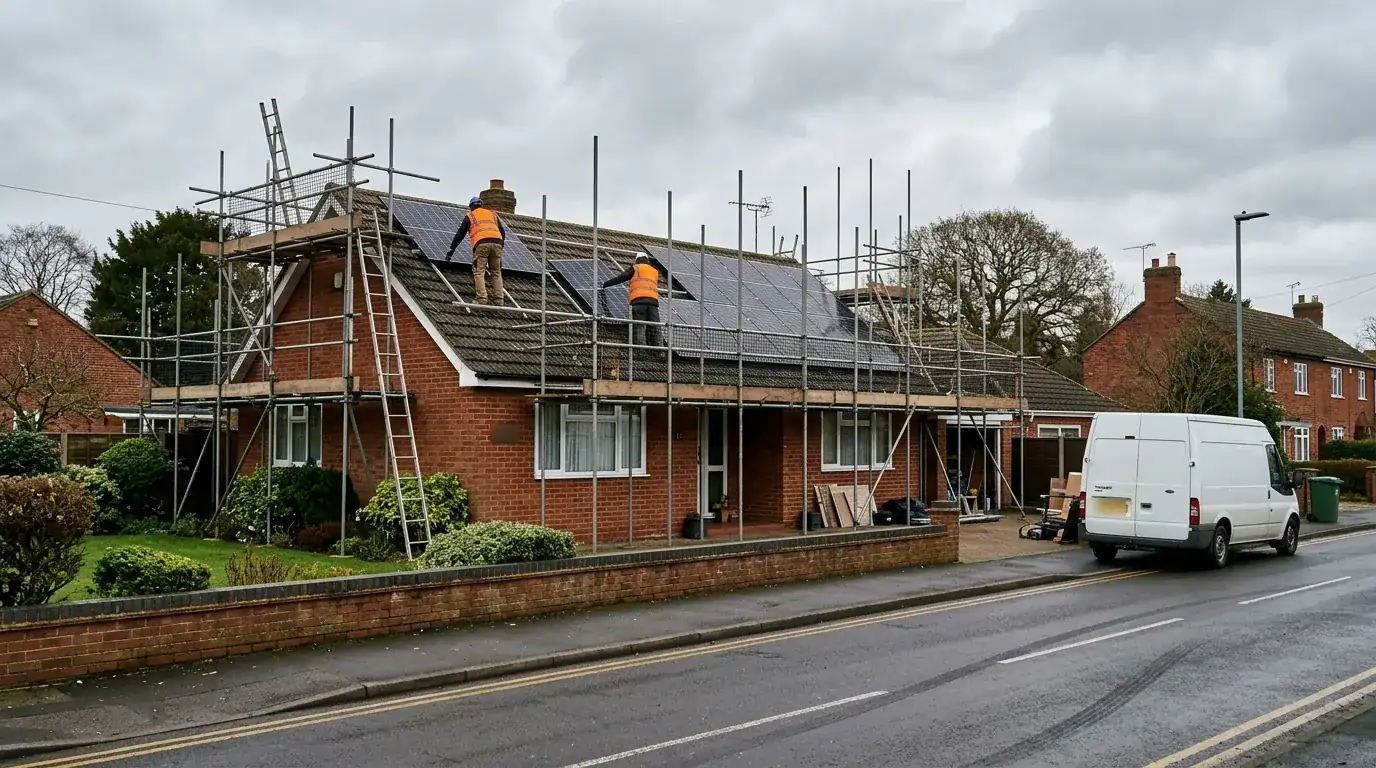
Demand is high. A record 207,619 MCS-certified installs had been recorded in 2026 by the autumn (Solar Power Portal). Busy periods mean longer waits, so starting early gives you more choice of date and more time to compare.
Should I rush to beat the VAT deadline?
No. A few hundred pounds of VAT matters, but a poor installation or an over-priced quote costs far more. Use the deadline as a reason to start comparing now, not to sign on the day.
It also helps to keep it in proportion. Even at 5%, home solar will still carry far less VAT than most home improvements, which are charged at the standard 20% rate.
Be wary of any salesperson who uses the deadline to pressure you. MCS-certified installers are not allowed to use high-pressure selling (Energy Saving Trust). Our guide to choosing an installer lists other red flags.
What does a sensible timeline look like?
There is no fixed rule, but working backwards from 31 March 2027 helps:
Autumn and winter 2026: get quotes, compare them, and check whether you qualify for a grant.
Early 2027: agree a survey and a written installation date that leaves some slack before the end of March.
Before signing: confirm in writing what happens to the VAT if bad weather or supply problems delay the job.
Winter installs are normal. Panels can be fitted in most weather, though very wet or windy days can move a booking.
What should I do now?
Get two or three quotes from MCS-certified installers.
Ask each one for a written installation date and VAT position.
Check whether you qualify for a grant first. See solar grants in Nottinghamshire.
Read our 2026 cost guide so you know what a fair price looks like.
Quick answers
The short version, if you're in a hurry.
When does 0% VAT on solar panels end?
It ends on 31 March 2027. From 1 April 2027, home solar and battery installations are due to go back to 5% VAT.
Will VAT on solar go back to 20%?
No. The plan is for it to return to the reduced rate of 5%, not the standard 20% rate.
How much extra will 5% VAT add?
Five per cent of the price, so about £375 on a £7,500 system or about £600 on a £12,000 system with a battery.
Does paying a deposit before April 2027 protect the 0% rate?
Not necessarily. A deposit may only fix the VAT on the deposit itself, so ask your installer in writing what rate will apply if the job finishes after the deadline.
Does the VAT deadline apply to batteries added later?
Yes. Since February 2024 batteries qualify for 0% VAT on their own or when added to existing panels, and the same 31 March 2027 deadline applies.
Could the government extend 0% VAT?
It could, but it has not said it will. It is safest to plan on 5% from April 2027 unless the government announces otherwise.
Solar in your part of Nottinghamshire
Local guides with council rules, grants and the villages each one covers.
Solar panels in Retford
Bassetlaw District Council · DN22
Read the Retford guideSolar panels in Worksop
Bassetlaw District Council · S80, S81
Read the Worksop guideSolar panels in Newark
Newark and Sherwood District Council · NG24, NG23
Read the Newark guideSolar panels in Mansfield
Mansfield District Council · NG18, NG19, NG20, NG21
Read the Mansfield guideMore guides
Sources
Figures last checked October 2026.
- GOV.UK – VAT on energy-saving materials (Notice 708/6)
- Heatable – solar panel VAT in 2027
- Reonic – VAT on solar panels in the UK
- Voltflow – solar panel grants UK 2026
- Heatable – solar panel costs
- Renewable Energy Hub – solar panels and battery prices
- RECC – Top tips for consumers
- Solar Power Portal – 2026 record year for rooftop solar
- Energy Saving Trust – Consumer protection