Finance
Solar panel finance: should you buy solar panels on finance?
You can pay for solar panels monthly through installer finance, a personal loan, a credit card or extra mortgage borrowing, but interest can stretch payback well beyond the usual 9 to 14 years. On our illustrative £7,400 system, a 10-year loan at 9.9% APR adds about £4,000 in interest. Notts Solar Quotes does not offer or arrange finance; we only introduce you to installers.
Free · no obligation · about a minute · Quick answers
Last updated
0% VAT on solar ends 31 March 2027. That's under six months away, and it's due to go back to 5% after.
What the VAT change means for youWhat are the ways to pay for solar panels on finance?
The main ways to buy solar panels on finance are installer finance, a personal loan, a credit card or borrowing more on your mortgage. Each spreads the cost of a typical 4kW system, which costs around £7,300 to £7,500 installed, or roughly £10,000 to £14,000 with a 4–5kWh battery. Paying from savings avoids interest altogether, so it is the cheapest route if you can afford it.
Installer finance is arranged at the point of sale, usually through a credit broker linked to a lender. A personal loan comes from a bank or building society you choose yourself. A mortgage further advance or green mortgage adds the cost to your home loan, often at a lower rate but over a much longer term.
Notts Solar Quotes does not lend money, broker credit or take any commission on finance. We pass your enquiry to up to three MCS-certified installers. If an installer offers you finance, the agreement is between you, the installer and their lender. Compare it with other options before you sign anything.
How does installer finance work, and how do I check it is regulated?
Installer finance means the installer introduces you to a lender, usually acting as a credit broker, and you repay the loan monthly while the installer is paid up front. Any firm that arranges consumer credit must be authorised by the Financial Conduct Authority. Solar installers who offer credit came under FCA regulation in 2014, when it took over from the Office of Fair Trading, as Solar Power Portal reported.
Before you sign, look up both the installer and the lender on the FCA Firm Checker. It shows whether a firm is authorised and has permission to sell you that product. The FCA warns about clone firms, so make sure the phone number and address you were given match those on the register.
The Renewable Energy Consumer Code says members who arrange finance must give clear, accurate details of the total amount payable, the monthly payment and the interest. Their savings and payback figures must take your loan repayments into account. They must not mislead you into a finance deal you would not otherwise have chosen. Ask for all of this in writing.
Is 0% finance on solar panels really free?
0% finance is only truly free if the price you pay is the same as the cash price and there are no fees. Some deals are interest-free, but many solar finance offers are not. For example, one large energy supplier launched solar instalment finance in 2024 over up to seven years at 9.9% APR, as Express & Star reported.
To test a 0% offer, ask the installer for a cash price and a finance price side by side. Check whether a deposit is needed, what happens if you miss a payment, and whether the 0% rate ends after a set period. Read the total amount payable on the agreement, not just the monthly figure.
Get quotes from more than one installer before you decide. A 0% deal on an expensive system can still cost you more than a fair cash price elsewhere. Our free service can put you in touch with up to three vetted installers, so you have fair quotes to compare against before you commit.
Should I use a personal loan or a green mortgage for solar panels?
A personal loan is usually quicker and keeps the debt separate from your home, while mortgage borrowing often has a lower rate but costs more interest over a long term. Personal loans are unsecured, so your home is not used as security. You choose the lender, which makes it easier to compare APRs across the market.
Green mortgages are mortgages that reward energy efficiency. The Energy Saving Trust says these can mean cheaper rates for efficient homes, cashback or extra borrowing for upgrades. Some deals only apply once work is finished or the home reaches a set EPC rating. Many need an EPC of B or better, according to NerdWallet.
Adding £7,400 to a 25-year mortgage can mean paying interest for far longer than the panels take to pay back. Mortgage borrowing is also secured on your home, so it could be at risk if you cannot keep up repayments. Check with your lender or an independent mortgage adviser before you borrow against your home.
Does Section 75 protect solar panels bought on finance?
Yes, Section 75 of the Consumer Credit Act can make the lender jointly liable if solar panels cost between £100 and £30,000 and you paid with a credit card or a linked point-of-sale loan. That means you can claim from the lender if the installer breaks the contract or misleads you. Which? says it applies even if you only paid the deposit by credit card.
The Renewable Energy Consumer Code says you can use Section 75 to ask the lender for a refund and to cancel the loan, even if the installer has stopped trading. If the lender's answer is not good enough, you can take it to the Financial Ombudsman Service. Keep copies of your contract, quotes and any sales leaflets to support a claim.
Section 75 does not cover debit cards or a separate personal loan you arrange yourself, because the lender is not linked to the installer. It also does not apply to the part of a price above £30,000. If you pay by debit card, ask your bank about chargeback instead, as Which? explains.
Is it worth taking a loan for solar panels?
A loan for solar panels can be worth it if the interest is low, but at higher APRs your repayments will usually be more than your savings while the loan runs. The figures below are illustrative only. They use a £7,400 4kW system, bill savings of £525 a year (the middle of our £400–£650 range) and an assumed £150 a year in export income. That totals about £675 a year, or £56 a month.
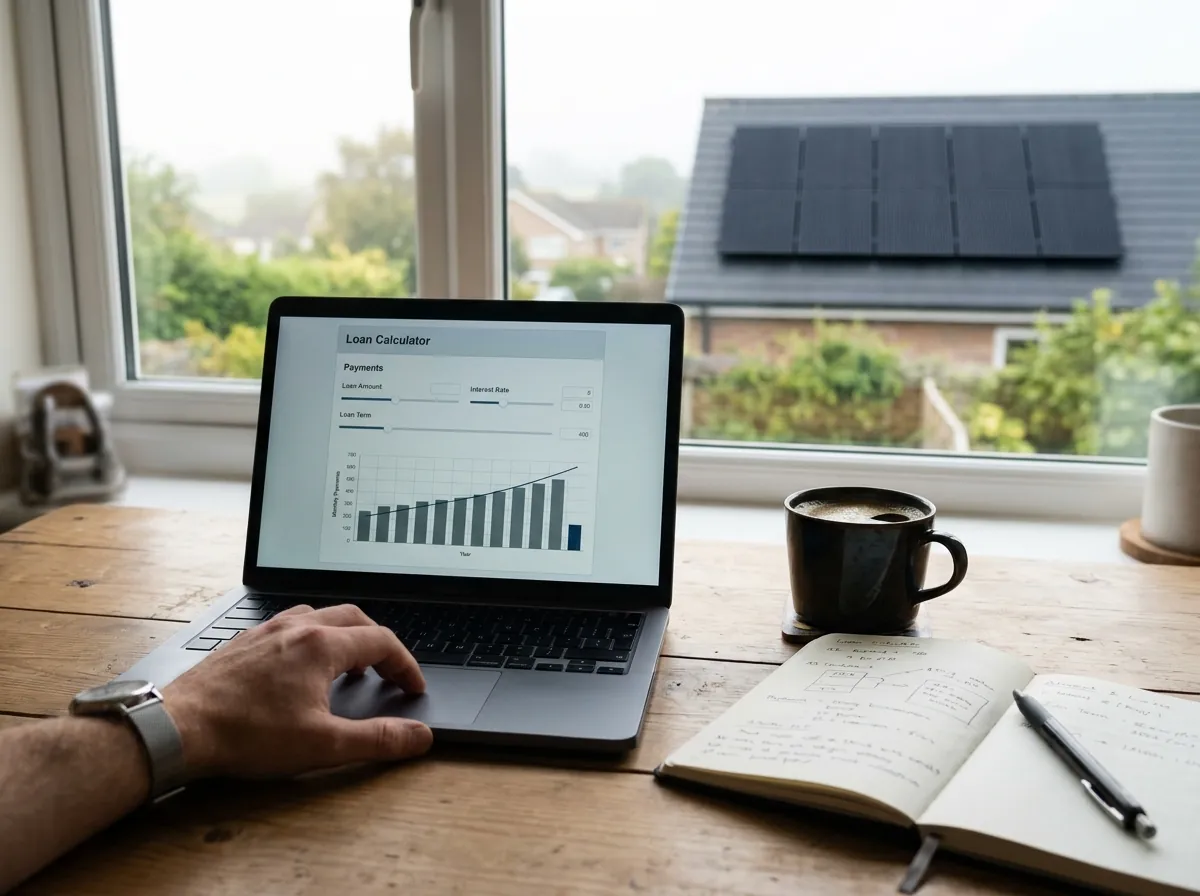
Illustrative example, assuming 9.9% APR: borrowing £7,400 over 10 years costs about £95.66 a month and £11,479 in total, including about £4,079 interest. Over 5 years it is about £155.33 a month and £9,320 in total. At 0% over 10 years it would be about £61.67 a month, with no interest. These are our own sums, not a lender's quote.
Paid in cash, this system would pay back in roughly 11 years. With the 10-year loan at 9.9% APR, the total cost of £11,479 takes about 17 years of savings to recover, and you would be roughly £40 a month out of pocket while repaying. Your real figures depend on your usage, roof, export rate and the APR you are offered. Ask installers for savings estimates that include your repayments.
Can I get solar panels on finance with bad credit?
You may still be offered solar panel finance with a poor credit history, but lenders must check you can afford it, and you are likely to be offered a higher rate or turned down. Lenders look at your income, outgoings and existing debts as well as your credit file. Each full application usually leaves a hard search on your credit file.
If you are refused, do not keep applying, as several hard searches in a short time can make things worse. Many lenders offer eligibility checks that use a soft search, which does not show to other lenders. Check your credit report for errors with a credit reference agency before you apply.
Be wary of any offer that says there is no credit check at all, as these can come with higher costs. You may also qualify for free or low-cost help instead. Ask your council about the Warm Homes: Local Grant, or call Nottingham Energy Partnership on 0115 947 2207. ECO4 is winding down and closes on 31 December 2026.
What solar finance mis-selling should I watch out for?
The biggest warning sign is a salesperson saying solar panels will "pay for themselves" or be "self-funding" while you repay a loan. The Financial Ombudsman Service has warned about misleading, high-pressure solar sales, often through cold calls to people near or in retirement, according to Solar Power Portal. Many complaints involved repayments that were higher than the savings.
The Renewable Energy Consumer Code found some people told their panels would pay for themselves ended up more than £1,000 worse off once loan repayments were counted. Thousands of complaints about solar panel loans have reached the Ombudsman, as MoneyExpert reported. Common complaints were lower income than promised and panels that did not cover the repayments.
Never sign on the day of a home visit. Make sure the paperwork clearly says it is a loan, not a grant. You normally have 14 days to withdraw from a credit agreement, but this does not cancel the panels contract itself, as Which? explains. If something goes wrong, complain to the lender first, then the Financial Ombudsman Service.
Quick answers
The short version, if you're in a hurry.
Does Notts Solar Quotes offer solar panel finance?
No. We do not lend, broker credit or earn commission on finance. We introduce you to up to three MCS-certified installers, and any finance offer is between you, the installer and their lender.
Is 0% finance on solar panels a good idea?
It can be, if the price matches the cash price and there are no fees. Always compare the total amount payable with cash quotes from other installers.
Do solar installers need to be FCA authorised to offer finance?
Yes. A firm that arranges consumer credit must be authorised by the FCA. Check both the installer and the lender on the FCA Firm Checker before you sign.
Will solar panels pay for themselves if I take out a loan?
Not always. In our illustrative example at 9.9% APR over 10 years, repayments were about £40 a month more than the estimated savings. Ask for savings figures that include your repayments.
Does Section 75 cover solar panels?
It can, if the system cost between £100 and £30,000 and you paid by credit card or with a loan linked to the installer. It does not cover debit cards or a loan you arranged separately.
Can I add solar panels to my mortgage?
Some lenders let you borrow more or offer green mortgage deals for energy upgrades. The rate may be lower, but you could pay more interest over a long term, and the debt is secured on your home. Check with your lender or a mortgage adviser.
Can I cancel solar panel finance?
You normally have 14 days to withdraw from a credit agreement, but you must repay what you borrowed plus interest to that date. Withdrawing from the loan does not cancel the installation contract.
Can I get solar panels with bad credit?
Possibly, but expect higher rates or a refusal, because lenders must check affordability. Use soft-search eligibility checkers first, and ask your council about grants you may qualify for.
Related guides
How much do solar panels cost in Nottinghamshire in 2026?
Read the guideGuideAre there solar panel grants in Nottinghamshire in 2026?
Read the guideSolar in your part of Nottinghamshire
See all areas we cover.
Sources
Last updated 25 October 2026.
- How to check a firm or individual is authorised – Financial Conduct Authority
- RECC provides guidance for consumers who take out loans to buy solar PV systems – Renewable Energy Consumer Code
- Section 75 of the Consumer Credit Act – Which?
- I want to cancel a loan I've taken out – Which?
- Guide to credit card protection – MoneySuperMarket
- How green mortgages can encourage home energy efficiency improvements – Energy Saving Trust
- Green mortgages explained – NerdWallet UK
- Ombudsman fires warning over misleading solar sales complaints – Solar Power Portal
- FCA regulation is positive for solar installers – Solar Power Portal
- Thousands complain to Financial Ombudsman about loans for solar panels – MoneyExpert
- Energy supplier launches buy now, pay later for solar panels – Express and Star
- Ombudsman decision DRN-3088707 (solar panel loan, sections 56 and 75) – Financial Ombudsman Service
- Can I finance solar with bad credit? – Kandoo